


What J.P. Morgan told us, and where we disagree.
What J.P. Morgan told us in Boston, and where we see it differently
The Federal Reserve raised rates Wednesday for the first time in three years, a quarter point to 3.75 to 4.00 percent on a 12 to 0 vote, and the 10-year Treasury yield crossed 5 percent for the first time since 2007. Stocks finished the week mixed, and oil held above $100 before easing on news that Saudi Arabia is restoring its main crude artery to the Red Sea. The morning after the decision, our investment committee spent the day in Boston with J.P. Morgan’s chief global strategist, David Kelly, and their portfolio managers. This week’s letter is what they think, where we agree, and where we don’t.
Also last week: the Russell 2000 fell about 1.5 percent, European markets closed lower Friday, the Bank of Japan raised rates to a 31-year high, and bond prices slipped as the 10-year crossed 5 percent.
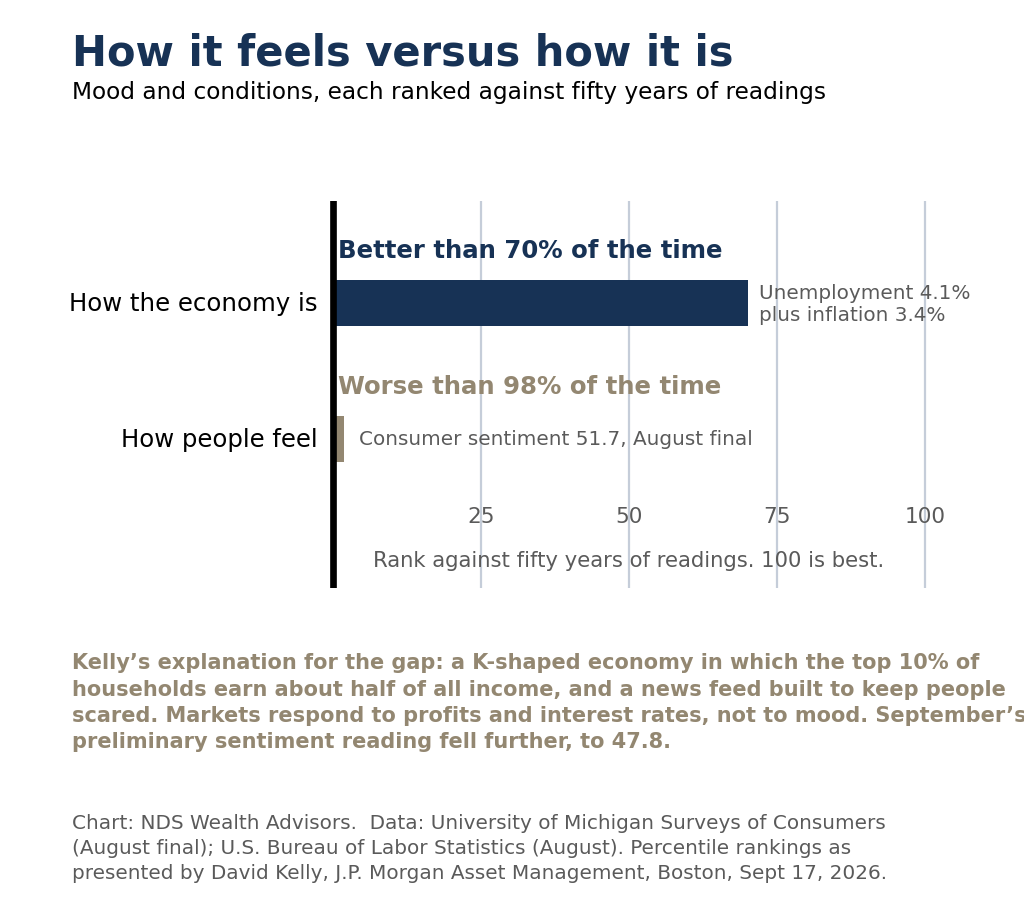
What J.P. Morgan said. Kelly’s view is that the Fed raised rates because it had cornered itself, not because it had to. Inflation expectations implied by the bond market run about 2.4 percent over the next decade, oil is a drag on growth more than a driver of core inflation, and he expects growth of 1.5 to 2 percent next year with job gains slowing toward 50,000 a month as immigration nets out near zero. He sees one more increase, probably in December, then a long pause, and thinks the market pricing two more is too many. His larger point: the economy is only okay and the public feels miserable, yet markets are strong, because markets respond to profits and interest rates rather than mood, and because money flows into stocks far more easily than it flows out.
Where we stand. We agree with the diagnosis and disagree with the verdict. The Fed had told everyone it would not tolerate inflation, and then received hotter core prices, stronger payrolls, and a market pricing an increase above 90 percent. In that position the quarter point bought credibility, and a 12 to 0 vote suggests the committee saw it similarly. We also hold Kelly’s growth forecast a little more loosely than he does. With headline inflation at 3.4 percent and the consumer already cutting back, we plan for a range of outcomes rather than a center lane. Where we agree completely is the closing thought of his talk: the shocks that matter are the ones nobody predicts, and diversification is the only defense against a risk you cannot name.
What J.P. Morgan said. Their technology team argued the AI buildout is real and still early. The largest companies will spend past a trillion dollars on it, the return on that capital sits in the low teens today, below traditional cloud computing, and should rise as chips grow dramatically more efficient. They have shifted from the chipmakers that led the first half of the year toward software, where they now see more value, and they treat cybersecurity as a growing necessity as AI systems misbehave. Kelly’s warning came from the other direction: the next bear market usually begins where the euphoria peaked, and an index fund today is a bet on a handful of AI companies whether the owner knows it or not.
Where we stand. We agree with the concern about concentration. Seven companies now make up more than a third of the S&P 500, and a portfolio that simply mirrors the index carries that bet whether its owner chose it or not, which is why our asset allocation work treats those names as a position to size on purpose rather than an accident of the benchmark. Where we part ways is on the enthusiasm. We are a little more bearish than the room in Boston. We are not yet convinced the companies spending the trillion dollars will earn an adequate return on it, and the thing we watch most closely is what happens if the money stops: if capital markets tighten and the buildout has to be financed on cash flow alone. We agree with much of what J.P. Morgan said. We are simply more middle of the road about it, and less excited. For investors with large embedded gains in these names, tax consequences are part of the decision, not the whole of it.
What J.P. Morgan said. Their bond team’s case is that bonds pay real money again. The broad U.S. bond index yields around 5.3 percent, and starting yield has historically been the best predictor of the return over the following five years. They favor the middle of the curve, five to ten years, and named the seven-year as the cheapest point, because it can benefit if the economy slows without carrying the long end’s exposure to deficits and inflation surprises. They find most of their value off the index, in securitized credit and in the new wave of AI-related corporate bonds, and they believe active management earns its keep in bonds more reliably than almost anywhere else.
Where we stand. This is where we mostly agree. Bonds have gone from dead weight to real income, and starting yields near 5 percent change the math for every plan that spends. We agree on active management, since the index leaves out most of the market, and we are looking at duration ourselves, at whether the five-to-ten-year range now pays enough to add. We will move in steps rather than all at once, because a 10-year above 5 percent for the first time since 2007 and $40 trillion of federal borrowing counsel patience, and because Kelly himself named the risk that bonds may not rally when stocks fall the way they once did. But the direction of the conversation is the same in Boston and in Providence: bonds are back to doing a job, and we intend to let them.
What J.P. Morgan said. Their alternatives team made the case for private equity and private real estate in three words: growth, income, diversification. Only about 14 percent of companies are public, so a public-only portfolio misses most of the investable universe; private real estate has shown almost no correlation to stocks; and their real estate strategy holds nearly no data centers, on purpose, favoring advanced manufacturing sites where tenants pay a premium for power. They were candid about the industry’s problem. With the IPO market mostly closed, private equity distributions have run about 13 percent a year recently against a 20 percent long-run average, and choosing the manager matters more than choosing the asset class.
Where we stand. We have used alternatives in client portfolios before, and as an investment committee we have been researching them again, primarily through the lens of income and diversification rather than the pursuit of higher returns. We agree that public markets have become concentrated in a way that makes true diversification harder to find, and we took J.P. Morgan’s candor about distributions and manager selection as the right frame for any decision. More to come on this as we think through the market environment and where the next several years of returns are likely to come from. Any consideration for a client’s plan would come with the fees and the liquidity clearly explained.
Four rooms, four teams, and one conclusion each of them reached on its own: concentration is the risk, diversification is the answer, and the mood of the country is not an investment strategy. Kelly offered a number worth acting on. A 60/40 portfolio left alone since early 2020 is now closer to 74/26. That drift is where most of the risk in most portfolios lives, and it is fixable. We have been reviewing portfolios with exactly this in mind, rebalancing where appropriate, keeping allocations consistent with each client’s investment objectives and risk tolerance, and evaluating tax consequences as part of the process. We continue to evaluate planning opportunities for clients with significant unrealized gains. We continue to advise investors to be disciplined in adhering to their investment policy and patient when the markets’ winds are pushing against the planned course.
The President is scheduled to meet Gulf leaders next week, and markets are likely to remain attentive to developments involving the Strait of Hormuz because of their potential implications for energy prices. Rate futures, as reported by Trading Economics on Friday, put roughly even odds on another increase in October; Kelly expects December, and only if oil stays high. We return to the regular format next Monday, numbers in the usual place.
“You can’t predict. You can prepare.”
Capital at Work is our weekly letter on what the markets did and what it means, written so you can repeat it at your own table. It arrives by email every Monday morning. Subscribe here.
Sources Market data: J.P. Morgan Asset Management, Weekly Market Recap, September 21, 2026. Federal Reserve decision and market closes: CNBC and Kiplinger, September 16 and 18, 2026. Oil and gold settlements: Kitco and Investrade, September 18, 2026. J.P. Morgan views: presentations to financial advisors by David Kelly, chief global strategist, and J.P. Morgan Asset Management portfolio managers and specialists, Boston, September 17, 2026, paraphrased from our notes and recordings. Chart data: University of Michigan Surveys of Consumers and U.S. Bureau of Labor Statistics, with percentile rankings as presented by Mr. Kelly. Rate expectations: fed funds futures as reported by Trading Economics, September 18, 2026. Quotation: Howard Marks, Oaktree Capital memo, November 2001. NDS Wealth Advisors believes these sources are reliable but cannot guarantee the accuracy or completeness of third-party data and assumes no liability for errors or omissions.
Disclosures This material is for informational and educational purposes only and should not be relied upon as investment, legal, or tax advice, or a recommendation of any particular security, strategy, or investment product. Any economic forecasts or market outlooks expressed herein are forward-looking statements, subject to change without notice, and may not materialize. Investors cannot invest directly in an index. Index returns do not reflect the deduction of fees, commissions, or expenses, which would reduce overall performance. Past performance does not guarantee future results. Diversification does not guarantee investment returns and does not eliminate the risk of loss. This material does not consider the investment objectives, financial situation, or unique needs of any individual investor. Consult your financial advisor before making any investment decisions. Views attributed to J.P. Morgan Asset Management are paraphrased from presentations made to financial advisors on September 17, 2026, reflect the opinions of those speakers on that date, and are not recommendations by NDS Wealth Advisors. Alternative investments involve illiquidity, higher fees, and limited transparency and are appropriate only for certain investors.