


Capital at Work: Week of August 28, 2026
Stocks edged to records as inflation cooled and the consumer flinched
The S&P 500 touched another record on Thursday and finished a third straight winning week, though just barely. Tame inflation numbers gave markets their relief midweek. A tired American consumer took some of it back on Friday.
Also last week: Russell 2000 +1.2%, MSCI EAFE +0.6%, MSCI EM +2.7%, Bloomberg U.S. Aggregate −0.1%.
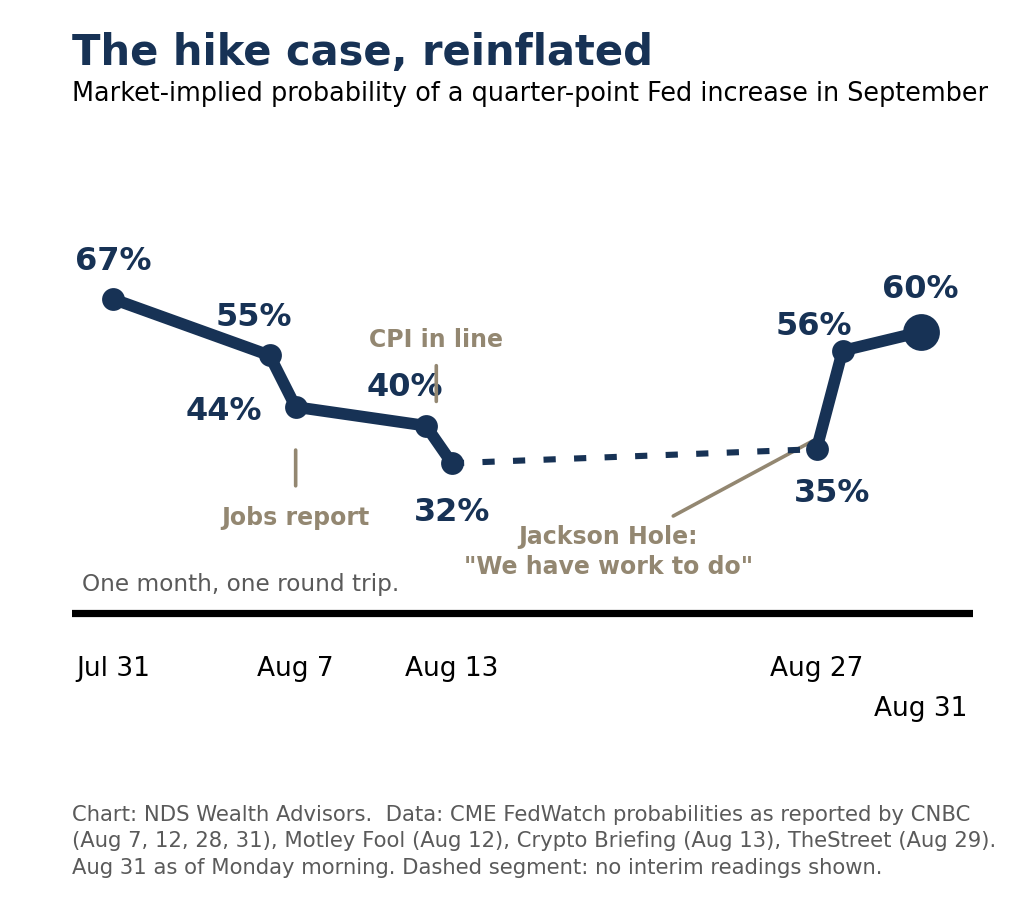
The week’s story changed on Friday. For most of the week, investors focused on earnings. Nvidia delivered another strong quarter and offered revenue guidance that reinforced confidence in the ongoing buildout of artificial intelligence infrastructure. Technology stocks responded accordingly, helping push the major indexes higher. Then Jackson Hole arrived. Federal Reserve Chair Kevin Warsh acknowledged recent improvements in inflation but cautioned that policymakers still lack confidence that underlying price pressures are moving decisively back toward the Fed’s 2 percent target. “We have work to do,” he told the room, and markets heard him. By Monday morning the implied odds of a quarter-point September increase stood near 60 percent, roughly double where they sat the day before the speech.
The latest inflation data itself was not alarming. July CPI rose just 0.1 percent month over month, headline inflation eased to 3.4 percent, and core slowed to 2.5 percent. Yet the bond market moved anyway. The 10-year Treasury yield finished the week near 4.73 percent, one of the highest readings of the year, as investors reassessed the odds of additional tightening. Higher yields weighed on rate-sensitive sectors and smaller companies, which is why the Russell 2000 fell in a week the big indexes rose.
Consumer sentiment remains weak. The University of Michigan’s final August reading came in at 51.7, and the Labor Department released a preliminary estimate that payroll employment could ultimately be revised lower by roughly 79,000 jobs, another data point in the debate about how much the labor market is cooling.
Oil fell more than 4 percent on the week to $83.40 as Washington shifted its pressure on Iran toward economic sanctions rather than military action and talks continued on an Oman-Iran shipping corridor, easing one of the market’s recent inflation concerns. Gold declined sharply as rising Treasury yields and a stronger dollar reduced demand for precious metals.
August is almost over, and the same tension that has defined much of 2026 still exists. On one side, earnings remain healthy, corporate investment in AI continues to accelerate, and inflation readings have improved materially from their highs. On the other side, inflation is still above the Federal Reserve’s target and policymakers continue to signal their willingness to tighten policy further if necessary.
For long-term investors, that is not a contradiction. It is simply the environment we are investing through. As always, we believe investors are best served by adhering to a disciplined investment strategy rather than attempting to predict the outcome of the next Fed meeting. Markets can change direction quickly. Financial plans should not.
The market enters September with a familiar question: is the economy cooling enough to bring inflation under control without slowing growth too much?
Next week’s calendar is full. Investors will be watching the ISM Manufacturing report, JOLTS job openings, ADP employment data, the ISM Services survey, and Friday’s August employment report for clues about the economy’s direction and the Fed’s next move. A stronger-than-expected labor market could reinforce expectations for additional tightening, while evidence of moderation could ease some of the pressure that has pushed yields higher in recent weeks.
Our view remains constructive but measured. Earnings continue to provide support for equities, inflation has moderated, and economic growth has remained resilient. At the same time, higher interest rates remind us that monetary policy remains an important force in markets. We expect economic data, not headlines, to drive sentiment in the weeks ahead.
“October. This is one of the peculiarly dangerous months to speculate in stocks. The others are July, January, September, April, November, May, March, June, December, August, and February.”
Capital at Work is our weekly letter on what the markets did and what it means, written so you can repeat it at your own table. It arrives by email every Monday morning. Subscribe here.
Sources Market performance and asset returns: LPL Research Weekly Market Performance, August 28, 2026; Associated Press market recap, week ending August 28, 2026. Oil settlement: CNBC, August 28, 2026. Treasury yields: U.S. Treasury market data as of August 28, 2026. Inflation: U.S. Bureau of Labor Statistics, Consumer Price Index, July 2026 release, August 12, 2026. Consumer sentiment: University of Michigan Surveys of Consumers, final August reading. Payroll benchmark revision: U.S. Bureau of Labor Statistics preliminary estimate, August 2026. Federal Reserve commentary: Chair Warsh’s Jackson Hole remarks, August 28, 2026, transcript at federalreserve.gov, and related coverage August 27 to 31, 2026. Rate probabilities: CME FedWatch, as reported August 27 through 31, 2026. Quotation: Mark Twain, Pudd’nhead Wilson, 1894. NDS Wealth Advisors believes these sources are reliable but cannot guarantee the accuracy or completeness of third-party data and assumes no liability for errors or omissions.
Disclosures This material is for informational and educational purposes only and should not be relied upon as investment, legal, or tax advice, or a recommendation of any particular security, strategy, or investment product. Any economic forecasts or market outlooks expressed herein are forward-looking statements, subject to change without notice, and may not materialize. Investors cannot invest directly in an index. Index returns do not reflect the deduction of fees, commissions, or expenses, which would reduce overall performance. Past performance does not guarantee future results. Diversification does not guarantee investment returns and does not eliminate the risk of loss. This material does not consider the investment objectives, financial situation, or unique needs of any individual investor. Consult your financial advisor before making any investment decisions.